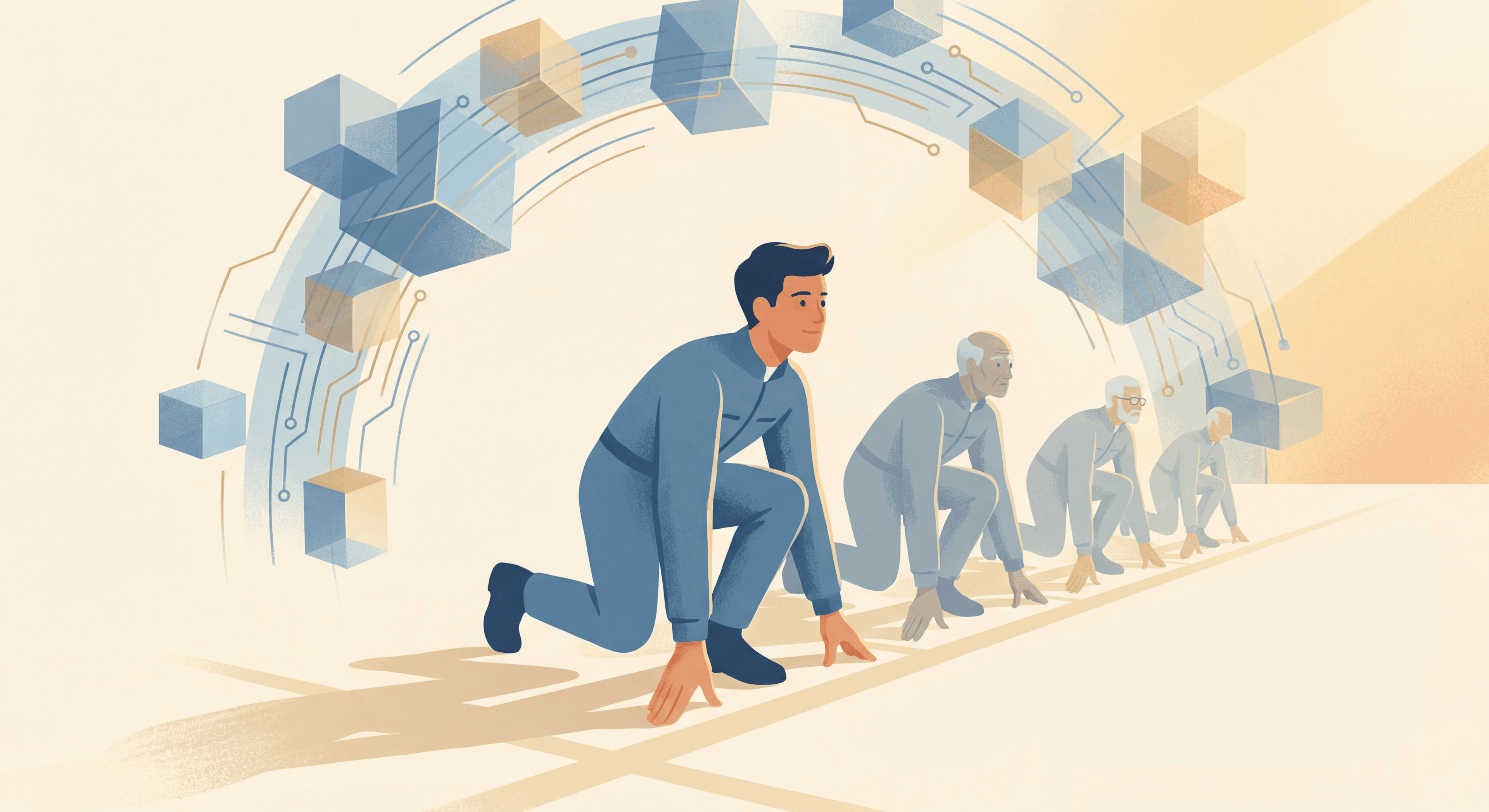
Every week I see another post about how AI is going to eliminate junior engineering jobs. The logic goes: if AI can write code, why hire someone who's still learning? Just have seniors prompt their way to features and skip the whole mentorship thing.
I think that's wrong. And I think the people who are most panicked are the ones who will be fine, as long as they actually lean into what's happening instead of running from it.
The opportunity is hiding in plain sight
Here's the thing about being a junior engineer (or a college student) right now: you have something seniors don't. Time and neuroplasticity.
I'm 27. I work full-time. I have commitments. When I want to learn a new tool, I have to carve out evenings and weekends. I have to fight against years of muscle memory telling me to do things the old way.
A college student? They can spend an entire semester going absurdly deep on AI tooling. They can rebuild their entire workflow from scratch. They can make mistakes on side projects instead of production systems. That's an enormous advantage.
The engineers who will struggle aren't the juniors. They're the mid-career folks who've been doing things one way for a decade and can't (or won't) adapt. They're good at what they do, but "what they do" is becoming less valuable every month.
Nobody has 20 years of experience
Here's the other thing people miss: AI tooling is a level playing field.
In traditional software engineering, experience compounds. A senior with 15 years under their belt has seen more failure modes, more architectural patterns, more edge cases than a junior ever could. That gap is real and it takes years to close.
But nobody has 15 years of experience with AI-assisted development. Nobody has even five. The tools we're using today barely existed two years ago. Claude, GPT-4, Cursor, Copilot: we're all figuring this out in real time.
That means a motivated college student who spends six months going deep on AI tooling can catch up to (or pass) a senior who's been casually using autocomplete. The experience advantage that usually protects senior engineers doesn't exist yet.
This won't last forever. Eventually there will be engineers with a decade of AI-native development under their belt, and that experience will matter. But right now? The field is wide open. A junior who takes it seriously is starting from the same place as everyone else.
AI fluency is the new literacy
Remember when "knowing how to Google" was actually a skill? There was a generation of engineers who were better than their peers simply because they could find answers faster. That advantage evaporated once everyone figured it out.
We're in that exact moment with AI. Right now, knowing how to use Claude or Copilot or Cursor effectively is a genuine competitive advantage. Most engineers are either ignoring these tools entirely or using them superficially (autocomplete and nothing else).
If you're a junior who actually understands how to prompt well, how to break problems down for AI, how to verify and iterate on AI-generated code, you're not competing with other juniors. You're competing with mid-level engineers who are still doing everything by hand.
In two years, everyone will know how to do this. In five years, it'll be table stakes. But right now? It's an edge. And juniors are in the best position to develop it.
What AI actually does to the job
The doom scenario assumes AI replaces engineers from the bottom up. Junior work goes first, then gradually the AI gets smart enough to replace seniors.
But that's not how it's playing out. What's actually happening is that AI compresses the learning curve. Tasks that used to require years of pattern-matching (knowing which framework to use, understanding boilerplate, debugging common errors) now take weeks because you have an always-available mentor who's seen everything.
That doesn't eliminate the junior role. It accelerates it.
Companies will still need humans who understand the business context, make judgment calls, and take responsibility when things break. AI doesn't do that. What changes is how fast a motivated junior can get to the point where they're making those calls.
If anything, the ceiling is higher now. A junior who actually puts in the work can be operating at a senior level faster than any previous generation. That's not a threat to juniors. It's an opportunity.
The skill that matters most
Here's what I've learned from running an AI agent as my de facto junior engineer: the hard part isn't writing code. It's knowing what to build and why.
AI is very good at "how." It can implement almost anything you ask for, given a clear enough spec. It's still pretty bad at "what" and completely useless at "why."
Deciding what problem is actually worth solving, understanding user needs, making tradeoffs between competing priorities: that's still human work. And it's learnable. You develop it by shipping things, talking to users, making mistakes, and iterating.
Junior engineers who focus on building that judgment (not just technical chops) will be fine. The ones who treat engineering as pure code-writing are the ones who should be worried, and they should have been worried five years ago anyway.
What I'd do if I were in college right now
Stop thinking of AI as a threat and start thinking of it as a power tool. Specifically:
Go deep on one AI coding tool. Don't just turn on Copilot and let it autocomplete. Learn prompting, context management, how to break down complex problems. Cursor, Claude, GPT-4, doesn't matter. Pick one and get actually good at it.
Build things constantly. The learning curve is shorter now, which means you can ship more projects in the same time. Each one teaches you something. Ten half-finished projects are worth less than three shipped ones, but three shipped projects are worth more than ever because you can build them faster.
Understand the whole stack. AI makes it easier to jump between frontend, backend, infra, and data work. Take advantage of that. Specialists will still exist, but generalists who can move between layers are increasingly valuable.
Pay attention to what AI is bad at. That's where the durable human value is. Ambiguity, judgment, communication, understanding messy real-world requirements: these are the things that won't get automated away.
The people who should actually be worried
The danger zone isn't juniors. It's anyone who's coasting.
Mid-level engineers who've been doing the same job the same way for years, relying on institutional knowledge rather than adaptability. Seniors who haven't shipped anything outside of work in a decade. People who view learning as something that stops after college.
AI is a forcing function. It rewards curiosity, adaptability, and relentless learning. It punishes complacency. That's always been true to some extent, but now the stakes are higher and the timeline is compressed.
If you're a junior or a student reading this, you have the advantage: no bad habits to unlearn, time to invest, and a front-row seat to the biggest shift in software engineering since the internet.
Don't waste it being scared. Go deep.